----------- ONE GOD, ONE GRANTH, ONE PANTH, ONE MARYADA -------------
beeraa aapan buraa mittaavai ||
One who eradicates his own evil is a brave warrior;
Vahiguroo Ji Ka Khalsa Vahiguroo Ji Ki Fateh! It seems that our community has lost its senses. We are investing Sangats hard earned money into buildings but not into Sikhi. In the Punjab there are massive Gurudwaras that are empty every evening, and morning in many villages. In the UK we have the same disease spreading. Is making a massive building really a success? Is it really such a big deal? Or is it a big deal that one child learns Japji Sahib by heart, or the Sikhs aid the local community, provide shelter, or provide other facilities. In the U.K, Sangats have spents hundreds of millions of pounds, in making large buildings, which will burden the future generations with cost of repair. Southall has a huge heroin problem, but over 20 million was spent on bricks. Now we have another example of gross mismangement of Sangats funds. Why not buy an estate with 5000 acres with that amount of money. Small minds do small things. We have a made Sikhi a form of materialism, that a huge building reflects our faith. Our dedication to Gurbani and form is what the Guru asked for, but to deflect from this, we build large idols. What could we have spent 11 million on: 1. Sikh research. We have no permanant Sikh Chair in the UK. Therefore we have no academic represention by Sikhs at that level. 2. Invest in the youth, pay for peoples education. Invest in people not cement. 3. Provide care for our elderly citizens. 4. Tackle alcoholism and drug abuse amongst Sikhs 5. Domestic violence 6. Campaign against female infanticide. Real issues for real people. Buildings are fake issues for the fake Khalsa. Every week a Sikh in the UK converts to Islam. Why havent we funded youth Parchar? Why isnt Katha done in English to an English speaking youth? The reason people convert is that our Muslim brothers fund their youth, and spend money educating their youth in Islam. We only educate our kids to make money....to have bigger cars, and bigger houses. The reality is we are empty inside, like this Gurughar will be most hours of the day. How many Muslims kids know the Qu'ran and how many of our kids know Guru Granth Sahib? Our kids dont even know why they have Kesh, or Mathha tekh. They dont even know why they wear a Kara! Do we make bigger Gurdwaras because we have bigger and bigger weddings, for marriages that sometimes last less than 6 weeks? Thats probably one of the reasons. Sri Darbar Sahib is modest in size compared to these modern American size Gurdwaras yet because of the devotion, it is the heart of Sikhi. In the past we had visable enemies, the Moghuls, the turaks etc.....now our biggest enemy is the materialism, and cozy comforts that are eating our community up. But I spose we are all going to say 'its not my problem', the Gianis is like this like that.... If your sending your son or daughter to university this year, just remember our Muslim brothers have over 5 millions pounds to fund conversion each year. Kamalroop Singh Nihang
The words in Shironmani Gurdwara Parbandak Commitee are peculiar. Three words are from Gurmat, Gurbani, another from English. This clearly reflects the effect of the British administration on Sikhs.
Gurmatta is Khalsa maryada, where the whole Panth gathers to make a decision. Votes have never been a part of our way of life, until the inception of the SGPC. Now we find this model all over the world, and Gurdwaras have commitees and votes cause politics, divides and eventually violence.
Which Guru made a commitee? The Panth has been run by the Panj, and the Jathedar of the Panj. Not secret whispers and parcels of money delievered to get votes! Even the Akal Takht Jathedar today has to answer to the commitee! This never ever took place in history.
Gandhi wrote to the SGPC founders and said as long as you are a religious body and do not deal with secular matters, or ask for Khalsa Raj, then I can support you. SGPC made Sikhi into a religion, when before this time Sikhi was a Dharma of Miri/Piri!
It is about time the Panth called for the dissolution of the SGPC, the original declaration of the SGPC was until the institutions in the Panth come into balance, the SGPC will exist: ਸ਼ਿਰੋਮਣੀ ਗੁਰਦੁਆਰਾ ਪ੍ਰਬੰਧਕ ਕਮੇਟੀ, ਪੰਥ ਦੇ ਵਿਚਾਰਵਾਨ ਸਾਰੇ ਜਥੇ ਅਤੇ ਸਮਾਜ, ਦਿਲੋਂ ਚਾਹੁੰਦੇ ਹਨ ਕਿ ਗੁਰਦੁਵਾਰਿਆਂ ਦਾ ਪ੍ਰਬੰਧ ਹੋਰਨਾਂ ਲਈ ਉਦਾਹਰਣ ਰੂਪ ਹੋਵੇ, ਪਰ ਜਦ ਤੀਕ- ਗੁਰਦੁਆਰਾ (ੳ) ਗੁਰਦੁਆਰਿਆਂ ਦੇ ਸੇਵਕ ਗੁਰਮਤ ਦੇ ਪੂਰੇ ਗਾਤਾ, ਵਿਦਾਨ ਅਤੇ ਸਦਾਚਾਰੀ ਨਹੀਂ ਹੁੰਦੇ, ਗੁਰਦੁਆਰਾ (ਅ) ਜਦ ਤੀਕ ਉਦਾਸੀ, ਨਿਹੰਗ, ਨਿਰਮਲੇ, ਨਾਮਧਾਰੀ ਆਦਿਕ ਫਿਰਕੇ ਤਅੱਸੁਬ ਛੱਡਕੇ ਆਪਣੇ ਤਾਂਈ ਇੱਕ ਪਿਤਾ ਦੇ ਪੁਤ੍ਰ ਜਾਣਕੇ ਭ੍ਰਾਤ੍ਰਿਭਾਵ ਦਾ ਵਰਤਾਉ ਨਹੀਂ ਕਰਦੇ, When all the samprada are organised it would dissolve. Well the time has come. All the Gurdwara commitees world-wide should be dissolved as they have no basis in Sikh maryada.
The qualifications of elected members in the THE SIKH GURDWARAS ACT, 1925 is as follows:
Qualifications of elected members.— (1) A person shall not be eligible for election as a member of the Board if such person— (i) is of unsound mind; (ii) is an undischarged insolvent, (iii) is a patit; (iv) is a minister of a Notified Sikh Gurdwara, other than the head minister of the Darbar Sahib, Amritsar, or of one of the four Sikh Takhts specified in clause (ii) of sub-section (1) of section 43. (v) is a paid servant of any Notified Sikh Gurdwara, or of the Board other than a member of the executive committee of the Board.
(vi) being a keshadhari Sikh is not a amritdhari; (vii) takes alcoholic drinks; (viii) cannot read and write Gurmukhi.] (2) No person shall be eligible for election as a member of the Board if he is not registered on the electoral roll of any constituency specified in Schedule IV. (3) Notwithstanding anything contained in sub-section (1) no person shall be prevented from standing as a candidate for election as a member of the Board on the ground that he is a patit, but if a person elected is thereafter found under the provisions of section 84 to be a patit his election shall be void.
How about knowing Gurbani? Having served the Sikh Panth? Knowing Kirtan?
It is under this commitee Sikhi has been distorted, banis cut down, liturgies rearranged, controversies started.............the list is endless...........votes do not lead to truth, the person with the most money and influence win. Sikhi was inherited by the meek and humble, not politicians.
In the past, the Jathedari was given due to day and night seva, now a new Jathedar is voted in by those in charge. How can we take such a commitee and Jathedar seriously?
Look at how Jathedar Vedanti who should have served us for life was unceremoniously removed!
How can a Jathedar be voted in without the blessing of the whole Panth? HOW WILL THIS BE WRITTEN IN OUR HISTORY?
Conclusion:
Based upon maryada, Gurbani and history; the SGPC and its appointments of 'Jathedars' have no validity or meaning, it is nothing more than a facade. The true guards of the Akal Takht were Saint Soldiers, now they are not even Saints but 'priests'. Who ritually conduct what their ruling masters tell them. This shows that even our 'leaders' are selected by the political masters and are just puppets for those who control them.
Well all know what happended to the Masands...............
At Anandpur Sahib is the well to this day where they were punished by the Guru. The same fate awaits the Masands of today. They can hide, but one day there will be nowhere to run.
Should Sikhs be using money from gambling, e.g the various Lottery Funds to do Seva? Would Guru Arjan Dev Ji have taken this type of money, that is not from honest labour, to complete the Darbar Sahib, Sri Harimandir Sahib (The Universal Temple of God)?
If we think this money is o.k to take, then could we use the money from brothels, and drug dealing to further our projects?
I think Sikhs that use this money have become beggars, and have lost all sense of integrity! The Sikh rahit is clear about this, gambling is not allowed and is considered a major tankha. Then, as Sikhs how can we feel justified to use this black money?
Here is a list of Sikh organisations that have applied for handouts:
Guru Teg Bahadur Sikh Gurdwara in Nottingham - £171,000 Network of Sikh Organisations (NSO) Sikh Cyber Museum Guru Nanak Sikh Museum in Leicester Khalsa woods: Heritage Lottery Fund: £17,599 Sikh Society Milton Keynes Sikh Community Care Project (SCCP) East London Karamsar Gurdwara, Ilford Guru Nanak Community Centre Bedford £934,122 GRDP Project: ASHT Development Project Amount awarded: £660,000 Applicant: Asian Health Heritage Amount awarded: £49,900 Applicant: Eastern Arts Partnership Amount awarded: £59, 000 Applicant: Sikh Sanjog Grant awarded: £20,800
An sarup of Adi Guru Granth Sahib Ji that was commenced in 1661 AD showing Mundavani Mahalla 5, and Sri Rag Mala. It was written in Keeratpur Sahib.
http://www.ragmalagurbanihai.info/ A new web site, providing information about how Ragmala with photographic evidence, proving that Mundavani by Giani Gurditt Singh is simply misinformation.
1. To battle against those people or ideologies that are destructive, that hurt, divide, enforce, manipulate, coerce, bully, intimidate, slander, brainwash, murder, rape, the innocent people.
How? With dialogue or the pen first; then if all other means fail the sword. (as said Guru Gobind Singh Ji)
What is mindless violence?
1. To hurt the innocent, slander, divide community, enforce will on another, rape women or men, intimidate people, manipulate the weak to do something, bully people into submission.
It is with sad regret that we have arrived at a vulgar level as a community. Any incident that occurs happens our first solution to resolve it is with violence. People aim to hurt the person mentally and physically, rather than punish them.
Recently a young man had his jaw broken in two places by a so-called preacher by his five henchmen. Did they want to punish him for talking to a girl on face book, or humiliate him, or did they wish to hurt his very being; for life? It looks like the second .....so are you in Dharam or are you one of those people the Guru called dusht, or dokhi, are you a giver of pain or of peace to other beings that have the right to live like yourself?
Setting peoples cars on fire, slandering them on the internet, giving them threatening phone calls, creating malicious gossip, boycotting them, beating or stabbing them with weapons from behind are not Sikh actions.
It is the action of BEMUKHS, those who have turned their face away from Dharam. It is the action of criminals in the guise of being Sikh.
Be Sanmukh and fight the person with dialogue, then a punishment given by some Panj Singh with authority, not your local ghetto of mates.
How can a Sikh use this kind of language while describing the holy Shahids? Is this neo-Gangstar Sikhism what we wish to portray to the world, and the youth? If a non-Sikh had written this, what would be the response?
I’ve already shared one Badass with everyone, now it’s time to drop another.
I’m going to go out on a limb here and assume that the majority of my readers aren’t exactly experts on Indian history, so it’s probably a safe assumption that you’re not familiar with the story of the Sikh martyr Baba Deep Singh. Well, it’s time to get educated — because this dude is one of the most hardcore freedom fighters to ever live, and a guy so extreme balls-out in his insatiable quest for vengeance that something as inconsequentially-trivial as being fucking decapitated couldn’t stop him from crushing his enemies to death with his nutsack.
Mcleod has written a number of books on Sikhism, he completed his doctorate many years ago, and has published a number of books since. In one of his recent publications he writes:
"The style of Jap is simple in the extreme, consisting solely of words testifying to the awesome greatness of Akal Purukh without any pretence of sentence construction. We can accept it as probably the work of Guru Gobind Singh." Mcleod 2007. Oxford University Press. YMCA Library Building, Jai Singh Road, New Delhi
"Most of the poem does not have even a rudimentry sentence construction" .p.61. Ibid.
I would argue that:
Jap Sahib is a poetical compostion, most poetry does not involve itself in sentence contruction. The Jap Sahib is written to give qualitative feelings (warrior spirit), over grammatical and other minute details. Jap means contemplation, repetition, meditation, therefore it is to be repeated, and memorised.Therefore to compare the Jap Sahib to prose, is unfair, uneducated, and is an attempt to find criticism by evaluating Jap Sahib unnecessarily outside of the framework of its style. This is methodologically flawed, and the condescending tone of Mcleod is poor. It would be interesting to find out what he actually means by pretense in the sentence.
Another one of Mcleods well calculated methods, is his belief of authenticity being credited via proof. He employed this method in his analysis of the Janam-Sakhis. (The life stories of the Gurus, mainly Guru Nanak.) Talking about this endevour he argues that little of the Janam Sakhi can be seen as historical truth.
" Concerned Sikhs were, however, uneasy with it as it specialized in miracles and wonder stories that educated Sikhs could accept only with difficulty"
" The Puratan version offered plenty of miracle stories, but these lacked the grotesque nature of the Bala version."
To look at a hagiographic scripture as historical literature seem quite fruitless in the first place. To evaluate fables, allegorical tales, in the light of history seems to be quite absurd in my opinion. This is like viewing many of the tales of miracles in most world religious scriptures as historical events. Whether they are from Hinduism, the bible, the Qur'an, all of them would fail under objective examination. When most religious literature is subjective, allegorical, didactic, instructive, religious, surely they should naturally be examined in that way?
In conclusion Mcleod is not a theologian, a linguist, or a philosopher. He is a historian with peculiar methods for dissecting the Sikh tradition with his scalpel. He endevours to perform his operations on areas of the Sikh canon that have no real need to be operated on, with procedures that are utterly useless for the operation. It is of no suprise that his conclusions are a Frankenstein mismatch due to his methods, that seldom have any conclusive outcome. In general his work leaves the reader with no new research, or understanding, than they began with. Unless the reader was completely devoid of any knowledge of the Sikh Dharma in the first place. The later would be impressed by his work, while the learned in Gurmukhi watch with great amusement.
The Shastarvidiya websites claim that the fighting art that they teach is Hindu-Sikh. That it is ancient and has come from the Shiva Akhara. That it is original, and pure. Please visit the website for confirmation.
There are a number of questions that arise:
1. If the combat arts of the Sadhus was so good, why was India invaded, and plundered for over 800 years? 2. Why was it that until the Guru sent Banda Singh Bahadur there never had been conclusive victories against the Moghuls?
Answer:
The Indian fighting art was out of date, the weapons were poor, and the Moghul tactics and technology was superior. The Guru therefore revealed new innovations like Mool Pentra, weapon construction, formations, tactics and strategies that had not be seen before. This was original and unique to the Sikh Panth. This is what real Shastarvidiya, or Jhatka Gatka is.
Therefore it seems that the use of the terms on the shastarvidiya.org website has other motivations.
The ethical codes written in Sankrit texts related to warfare, also do not correlate with the practices of the Khalsa Panth.
Cunningham writes in 1849:
"the Sikh owes his excellence as a soldier, to his own hardihood of character, to that spirit of adaptation which distinguishes every new people, and to that soldiers. feeling of a common interest and destiny implanted in him by his great teachers. The Rajpoots and Puthans are valiant and high-minded warriors : but their pride and their courage are personal only, and concern them and Pu- as men of ancient family and noble lineage ; they will than8, do nothing unworthy of their birth, but they are indifferent to the political advancement of their race. The efforts of the Mahrattas in emancipating themselves ofMah- from a foreign yoke, were neither guided nor strengthened by any distinct hope or desire. They became free, but knew not how to remain independent, and they allowed a crafty Brahmin to turn their aimless aspirations to his own profit, and to found a dynasty of " Peshwahs" on the achievements of unlettered Soodras. Ambitious soldiers took a further advantage of the spirit called up by Sevajee, but as it was not sustained by any pervading religious principle of action, a few generations saw the race yield to the expiring efforts of Mahometanism, and the Mahrattas owe their present position, as rulers, to the intervention of European strangers. The genuine Mahratta can scarcely be said to exist, and the two hundred thousand spearmen of the last century are once more shepherds and tillers of the ground. Similar remarks apply to the Goorkhas" p. 173.
The excessive use of cannabis is forbidden in the Nihang Maryada, where only a pinch was used, to aid digestion. However some people, become Bhangars, take it on another level. They scar themselves mentally for life, and encourage other people to take ever increasing amounts of Bhang. Most people who have a high tolerance to Cannabis Sattiva use opium regularly.
Those people who take too much cannabis get erectile dysfunction, mood swings, paranoia, narcissistic symptoms, under achieve, drop out from education, lie, cheat, decieve, look for free roti, steal from the sangat, manipulate people, free loaf, and become self obssessed.......
Some of them suddenly become reformed and turn into "Gurmukhs". Where they continue to get free roti, beds, money, attention, ............
Nihangs also do Jhakta, but they do not get sick gratification from killing animals. A person who treats jhatka and degh as a game, is already dead. It is better for a person with this type of mindset to leave the Panth and detoxify their minds and bodies, or better still not enlist in the first place.
Narcissistic personality disorder is a condition characterized by an inflated sense of self-importance, need for admiration, extreme self-involvement, and lack of empathy for others. Individuals with this disorder are usually arrogantly self-assured and confident. They expect to be noticed as superior.
It is difficult to recognize a narcissist because he (or she) spends all of his time acting, protecting his ego by presenting to the world a false image of himself. Consequently he becomes a master of deceit. But it is extremely important to be able to recognize people whose behavior is detrimental to their organization's performance. A narcissist is not capable of putting the organization's needs before his or her own needs.Ref Researchers have found that a narcissist reacts much more emotionally than a non-narcissist, sometimes with "narcissistic rage" when his (or her) ego is threatened.
Because of a propensity to internalize failure, the narcissist's emotional response to failure is to feel shame, as opposed to guilt felt by people without the disorder. So in order to avoid shame, which the narcissist feels must be avoided at all costs, he externalizes blame for negative events. Ref As he feels someone must be guilty, he almost always attributes blame to others. Only when his self-esteem is particularly high, perhaps through some positive feedback he has engineered, does he accept blame, and only then if it can be seen as a magnanimous gesture. A narcissist is someone who is overtly or subtly arrogant, exhibitionistic, vain, manipulative, and greedy for admiration. Narcissistic rage, character assassination and projection are some of the overt ways in which the narcissist expresses himself.
The denial of remorse and gratitude by the narcissist are two of the more subtle ways used to protect an internal sense of grandiosity. An example of a narcissist's ability to be subtle might be when he arrives late for a meeting. Rather than offer a sincere apology, he may blame someone else for keeping him talking, thus externalizing the fault ("It's not my fault") and maintaining his sense of grandiosity. Despite tending to be exhibitionistic, it is very rare to hear a narcissist brag or boast. Instead, he tends to 'drop' information in the form of an ostensibly ordinary matter-of-fact report, which appears to be intended to elicit admiration without asking for it. For example, rather than say, "I was so please to meet our CEO, Peter Smith", he will casually allude to "...lunch with Peter", in a way that induces a sense of distance and inferiority in the recipient of the information; again maintaining his sense of grandiosity.
Here are a few pointers that may help you identify one:
Their lack of empathy colours everything they do. They may say, "How are you?" when you meet, but they are working from memory. They are not interested in how you are. Virtually all of their ideas or ways of behaving in a given situation are taken from others, people they know and perhaps think of as an authority (mirroring). Their sense of self-importance and lack of empathy means that they will often interrupt the conversations of others. They expect others to do the day-to-day chores as they feel too important to waste their time on common things. Listen for the constant use of "I", "me" and "my" when they talk. They very rarely talk about their inner life, for example their memories and dreams. They feel that the rules at work don't apply to them. They will always cheat whenever they think they can get away with it. If you share workload with them expect to do the lion's share yourself. They love to delegate work or projects, then interfere by micro-managing it. If it goes well, they take the credit, if it goes badly they blame the person they delegated it to. There tends to be higher levels of stress with people who work with or interact with a narcissist, which in turn increases absenteeism and staff turnover. They get impatient and restless when the topic of discussion is about someone else, and not about them.
1. Not married, no female disciples - Most disciples are female or likes to hug up next to Singhs out of "pyar". Clearly homosexual. 2. Separate from maya - Regularly takes Sangats money 3. Does not touch money - Regularly checks the accounts 4. Not after a following - Into self promotion and making a following, gaining stages 5. Does not talk much - Can never keep quiet, and talks about their own life, with parrot like memorised Gurbani inbetween to keep the act up.Then does not talk for a week. 6. Does not eat much - obsessed by food after periods of not eating. 7. Does not sleep much - Regular naps 8. Vegetarian - Vegetarianism is the main philosophy of the cult.
9. Engrossed in Seva and Simran - Tells everyone else to do it, but sits on a Manja.Tries to use Gurbani to obtain occult powers, to trap people.
10. Loves existence - is cynical of all existence, has no trust, and looks suicidal, with manic episodes. Which he labells as Bairag and Chardikalah respectively.
Sukhamani Sahib talks about a true Sadhu, a Sadhu is one who is separate from materialism.
Sadh Ki Mehima Bedh Na Janai.
so saadhhoo bairaagee soee hiradhai naam vasaaeae That person is a Holy Saadhu, and a renouncer of the world, whose heart is filled with the Naam. Guru Amar Daas Ji Siree Raag 29
Real Sadhus know that lust is a very powerful force, therefore they always kept a respectful distance from women, to protect their own dignity and others. Today in Punjab and else where, women are the major followers of these fake Sadhus. When the sex drive is repressed and then reappears, it can become twisted and perverted. Hence why so many women are molested and raped by these fake Sadhus. People need to be educated as to what a real Sadhu is. Please pass the message on.
Today some of the youth doing Parchar, are like Chameleons and Snakes. They say different things to please in different sects to keep politically correct, for their own fame and glory. They have no sense of truth and they remind me of this character in the Jungle Book:
There are a number of them. When they are with different Jathas they adjust their opinions accordingly. In the "Panth" there are number of these chameleon like characters, who have no back bone, or any sense of integrity and truth. They just want to be worshipped and respected, as they are addicted to this. Please watch out for people who twist, turn, and change colour in seconds............
"A Khalsa cannot become a robber.
But there are many robbers claiming to be Khalsa.", said by Akali Sant Baba Nihal Singh Ji
They think they are political leaders, and have the right to create their own cancerous forms of Sikhism. They feel that their own thinking is higher than tradition and the Sikh Rahit Maryada. Rather like Teja Singh Bhasauria, Handalias, Ram Rai, Darshan Das, and so on. Many are in the garb of Khalsa roop. Please be careful. The Masands were taken care of by Guru Gobind Singh. May that day come soon...............................
For the chardikalah of the Panth please listen to Ugardanti as many times as possible. The total length is around 17 minutes. Please feel free to leave a comment.
Intensive farming methods, chemicals, GM-food, pesticides, have all taken their toll on the land of the Punjab. The desertification of Punjab is occuring, with the top soil eroding away, due to lack of tree planting, and not allowing the land to rest.
The Punjab is now full of drugs, alcohol, and gambling. The men are on drugs, and they are making the land chemically dependant. What have the so-called preachers done to educate people? The answer is nothing, because ignorant people are easier to manipulate.
Punjabi brothers wake up....before you find yourself in a barren desert.
In the Jap Ji, Guru Nanak bows down to the creativity of the Divine Being, Guru Nanak also describes the land as a mother. Therefore shouldn't Sikhs have some sense of environmental responsibility?
A reader of this blog, Stephen, commented:
There is another active part to desertification in your land and elsewhere: the aquatic weed Typha. Your nation has Typha elephantina and Typha angustifolia in large quantities. Typha is a dessication machine. The infestations in Africa are a driving force in the expansion of the Sahara. I'm a rabble-rouser and cheerleader for the control of aquatic weeds, particularly Typha. Typha appears to be the most dessicating of the bunch, because it survives the dry conditions it creates for quite some time. It is also the most exploitable of the problem weeds. It is an excellent energy plant, suitable for ethanol, biogas or charcoal production. When grown in clean water, it is an excellent food plant. Attached is a sketchy little plan I'm circulating for control by exploitation of aquatic weeds, to do with as you ill. It is oriented to Africa, but the plant is basically the same worldwide.
The plan Stephen has kindly provided will online very soon. Many thanks Stephen!
Kharag Singh Da Prasang in Dasam Granth Sahib Ji, was read by the Shahid Singhs. It is said Baba Deep Singh by reading this bani, was able to keep fighting, even while being decapitated. Dr. Harbhajan Singh writes that Kharag Singh represents the Khalsa. This is dialogue and battle between Kharag Singh (The King) and Shiv Ji:
Shiva spoke in anger, "O king ! why are you so proud? Do not indulge in strife with us; you will see just now what strength we have! If you have greater courage, then why are you delaying, why do you not take your bow and arrows in your hands? You have a very large body and by piercing it with my arrows, I shall lighten it."1505.
Speech of Kharag Singh addressed to Shiva: O Shiva ! why are you so proud? Now when there will be dreadful fighting, you will run away; with the infliction of a single arrow, all your army will dance like a monkey;All the army of the ghosts and fiends will be vanquished and there will be no survivor; O Shiva ! listen, this earth saturated with your blood will wear the red garb today."
Hearing these words, Shiva held up his bow and arrows and pulling his bow upto his ear, he discharged the arrow, which struck the face of the king; it appeared that Garuda had caught the king of the snakes.1507.
Then the king struck his lance, which hit the chest of Shiva; it appeared that the ray of the sun was hovering over the lotus.1508.
Saying this, the king took out his large dagger and in anger hurled it on the body of Shiva; after striking the blow of the dagger on the body of Shiva, the king roaring like the sea challenged him;Shiva fell down with the blow of the dagger; his necklace of skulls slipped and fell down; somewhere his bull fell down and somewhere his trident fell down.1523.
The Shiva became somewhat conscious and he fled away from the war-arena; other ganas, ran away in fear; there seemed to be no warrior, who could confront the king.1528.
CHAUPAI When Krishna saw Shiva running away, then he reflected in his mind that he would then fight with the enemy himself; either he would kill the enemy of die himself.1529.
Then Krishna went before the king and waged a dreadful war; making him the target, the king shot an arrow and dismounted Krishna from his chariot.1530.
Khalsa has a Dastar. Shiva has no dastar. Khalsa wears bana. Shiva wears a loin cloth. Khalsa is dark blue. Shiva is light blue. Khalsa carries a Kirpan. Shiva carries a trishool. Khalsa wears a Kamarkasa. Shiva does not. Khalsa keeps Kesh. Shiva keeps dredlocks. Khalsa has a beard. Shiva does not.
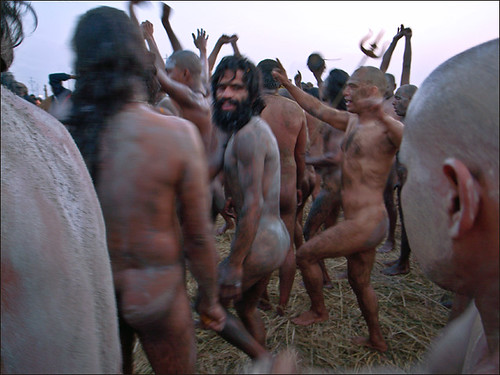
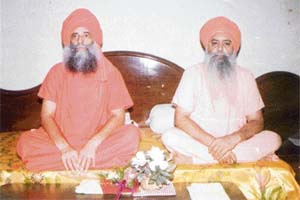
The word Sant means a seeker of the Truth, or one who has merged into the Truth. The word Sadhu means a renunicate from the world. Over the years many Sikhs have called Sadhus, Sants and vice-versa. The Nirmala Panth was of Sants, and Sadhus, some being gristi and others being celibate. The Udasi Panth was mainly Sadhus.
In the last 150 years in Punjab the Sadhu-Sant movement has been huge. Kahn Singh Nabha writes " the Sants are preaching eating meat is wrong, this is against Gurmat". The passive, Sadhu-Sant movement was patronised by the British rulers and Royal family. Many of the "great" Saints of the last 150 years were regularly visited by the British regency. Most Sants never wore a Kirpan, and were into Ahinsa, complete non-violence. This served the interests of the colonial rulers very well.
Today all over Punjab, there are an unknown number of white clad, vegetarian, passive, cultish Sants. The Sant movement originated in some respects out of the scholaristic movement of the Nirmala Sikhs, and aseceticism of Udasi's. These Sikhs wore Salmon Pink, orange, or white, and were scholars of Sanskrit. Mostly Sadhus, who were unmarried, they wrote books to defend the ideas of Gurmat, via giving "proof" from Vedant, or other Indian philosophies.
Most Sants today are unaware of their origins, and have been "reformed". As they follow the Sikh Rahit Maryada, and wear a Kirpan. Although it is fair to say, whether the Kirpan is sharp or usable, or if they know how to use it, is questionable. They prefer to stay Shant and in general keep away from the Bir Ras spirit. It is common in Sant deras to tell people not to read Chandi Di Var, or other Dasam Granth bani. However they do still believe it is Guru's bani. There are exceptions here like the Dam Dami Taksal who keep armed. While on the other hand Namdhari's read Dasam bani, but do not keep armed.
The old tradition was that a Sadhu could not keep worldy items, as a Sadhu was separate from maya. However the Sadhus of today put the Gangster rappers to shame, with the bling bling they have.
Nihang Sant Soorma Sahid Avatar Singh Brahma, who single handedly killed thousands of rapists, murders, and paedophiles in the Punjab police.For many years he practiced Jhatka, in the Baba Biddhi Chand Nihang Dal.
Some Nirmala scholars, paid off by their British masters, condemed the practices of the Khalsa in some texts. At one point they even attempted to create the Nirmala-Buddha Dal, but lost their battle in the British court. All of these were attempts to dissolve the Saint-Soldier ideal of the Khalsa created by Guru Gobind Singh Ji. Guru Gobind Singh told the Khalsa to be armed at all times, it is our right as a Sovereign Nation. " Saif Sarohi Saythee, Yahai Hamarey Pir". Shastar Nam Mala Puran. Dasam Granth Sahib Ji.
Nirmala Sant Giani's in the passive traditional Nirmal Bhek/dress.
However the Nirmala Sants kept the Sikh tradition alive when the Christians nearly converted all of Punjab to Christianity. This was a great service performed by them, for the Khalsa Panth. There also have been examples of Nirmala Saints like Bhai Maharaj Singh who fought against the British. In the next few weeks, there will be a post about the life of this great Brahmgiani.
The True Nirmala Sadhus like Baba Nand Singh were not gristi, never took money, and spent their whole life in meditation on Akal Purukh. Most of the Sants today are a mismatch, of Singh Sabha reform, Sikh Rahit Maryada, Vedant Hindu thought, Gristi Jivan, Nirmala Bhekh, etc. Brahmgianis like Baba Nand Singh Ji spent YEARS in unbroken meditation and gurbani, and YEARS in seva. Vegetarianism was originally linked to the idea of renunication, and those not living a gristi jivan, and spending literally hours in constant simran. See the Shabad at the end of the post:
"Forsaking these delicacies, one becomes a true Sannyaasee, a detached hermit. Nanak reflects and speaks. 2"
This was a sattvic lifestyle, and puritanical. For the Khalsa, Rajas Gun was needed, to fight in war, and to have energy to live in gristi. Strict vegetarians can often feel cold, withdrawn, and having low physical energy levels, depending on their strictness of diet. Ascetic vegetarian Sadhus used to meditate in the Indian Sun to keep warm, as well as infront of fires (dhuni). Whereas these feelings can help meditation, it can be detrimental to the body. Therefore the maryada of Jhatka existed in the Panth from the very beginning. As the Khalsa is a Karma-Yogi.
Baba Nand Singh Ji, on his Bairangam. In complete union with Akal Purukh.
Hindu and Jain Gujarati's are strict vegetarians, to make heat in their bodies, they add in lots of spices. In the UK many of them suffer from high blood pressure, strokes, diabetes, heart attacks etc. This could be due to their strict vegetarian, high carbohydrate, high fat, low protein diet. It could increase fat and decrease lean muscle.
In Gristi ashram meat is allowed. This was even written by the vegetarian Nirmala Sikhs. In the Prem Sumarag Granth, Guru Gobind Singh writes about Jhatka, and what types of meat to eat, as well as the methods of slaughter. In worldy life, physical energy is required. In spiritual life, mental energy is required. The Khalsa is the middle, therefore the Khalsa eats a balanced diet. Just eating meat, kills the energy of the mind. To just eat fruits, seeds, nuts and vegetables, eventually kills the energy of the body.
As soon as it is possible, on this blog will be a step by step guide of how to do Jhatka, with the various bani's from the Adi Guru Granth Sahib Ji and Dasam Granth Sahib Ji.
At Kurekshetra at a Hindu festival, Guru Nanak was brought as a gift a Deer, that had been hunted. It was being cooked, the Brahmins found and protested. See Janamsakhis of Guru Nanak, the Guru replied to the insulted Brahmins:
Salok, First Mehla:
First, the mortal is conceived in the flesh, and then he dwells in the flesh. When he comes alive, his mouth takes flesh; his bones, skin and body are flesh. He comes out of the womb of flesh, and takes a mouthful of flesh at the breast. His mouth is flesh, his tongue is flesh; his breath is in the flesh. He grows up and is married, and brings his wife of flesh into his home. Flesh is produced from flesh; all relatives are made of flesh. When the mortal meets the True Guru, and realizes the Hukam of the Lord's Command, then he comes to be reformed. Releasing himself, the mortal does not find release; O Nanak, through empty words, one is ruined. 1
First Mehla:
The fools argue about flesh and meat, but they know nothing about meditation and spiritual wisdom. What is called meat, and what is called green vegetables? What leads to sin? It was the habit of the gods to kill the rhinoceros, and make a feast of the burnt offering. Those who renounce meat, and hold their noses when sitting near it, devour men at night. They practice hypocrisy, and make a show before other people, but they do not understand anything about meditation or spiritual wisdom. O Nanak, what can be said to the blind people? They cannot answer, or even understand what is said. They alone are blind, who act blindly. They have no eyes in their hearts. They are produced from the blood of their mothers and fathers, but they do not eat fish or meat.
But when men and women meet in the night, they come together in the flesh. In the flesh we are conceived, and in the flesh we are born; we are vessels of flesh. You know nothing of spiritual wisdom and meditation, even though you call yourself clever, O religious scholar. O master, you believe that flesh on the outside is bad, but the flesh of those in your own home is good. All beings and creatures are flesh; the soul has taken up its home in the flesh. They eat the uneatable; they reject and abandon what they could eat. They have a teacher who is blind. In the flesh we are conceived, and in the flesh we are born; we are vessels of flesh. You know nothing of spiritual wisdom and meditation, even though you call yourself clever, O religious scholar. Meat is allowed in the Puraanas, meat is allowed in the Bible and the Koran. Throughout the four ages, meat has been used. It is featured in sacred feasts and marriage festivities; meat is used in them. Women, men, kings and emperors originate from meat. If you see them going to hell, then do not accept charitable gifts from them. The giver goes to hell, while the receiver goes to heaven - look at this injustice. You do not understand your own self, but you preach to other people. O Pandit, you are very wise indeed. O Pandit, you do not know where meat originated. Corn, sugar cane and cotton are produced from water. The three worlds came from water. Water says, ""I am good in many ways."" But water takes many forms. Forsaking these delicacies, one becomes a true Sannyaasee, a detached hermit. Nanak reflects and speaks. 2
Adi Guru Granth Sahib Ji, Ang 1289-90. Rag Malar: Guru Nanak Dev Ji.
Guru Gobind Singh:
If the Khalsa is independant. I bestow all power to it.
If they follow the way of the Brahmins, I have no faith in them.
1. The Sri Sahib is not just a symbol it has usage. The best way to train, to get the feel of any weapon, is to use it. Decapitating humans is simply out of the question, the Samurai used to practice on murders and rapists. To perfom Jhatka on a male goat is not against Sikh practices. In fact the Sikh Rahit Maryada allows this practice.
2. To apply ceremonial marks of Bhog on Shastar is also not against Sikh practices. As Karah Parshad has bhog, (ceremonial meeting between the Parshad and the Kirpan) called Kirpan Bhet. Jhakta is also another form of Kirpan Bhet. The flour was also alive at some point just like the goat:
Guru Nanak asks in Rag Malar "what is vegetable, what is meat?"
Guru Ji states:
Meat is allowed in the Puraanas, meat is allowed in the Bible and the Koran. Throughout the four ages, meat has been used. Guru Ji said this is response to a vegetarian pandit , protesting at the Guru cooking a deer for the langar, at Kurekshetra. See Bhai Bala Janam Sakhi, and Gian Ratnawali Bhai Mani Singh Ji. Also see the shabads in Guru Granth Sahib Ji angs 1289-90.
Conclusion: Jhatka is scaremental food for langar. Known as Mahaprashad see Bhai Gurdas Vara. If rituals are a problem, we should not have chaur, sukhasan parkash, bhog, etc.
ਨਰਾਜ ਛੰਦ ॥नराज छंद ॥NARAAJ STANZAਕਹਿਓ ਪ੍ਰਭੂ ਸੁ ਭਾਖਿ ਹੋਂ ॥ ਕਿਸੂ ਨ ਕਾਨ ਰਾਖਿ ਹੋਂ ॥कहिओ प्रभू सु भाखि हों ॥ किसू न कान राखि हों ॥I say only that which the Lord hath said, I do not yield to anyone else.
ਕਿਸੂ ਨ ਭੇਖ ਭੀਜ ਹੋਂ ॥ ਅਲੇਖ ਬੀਜ ਬੀਜ ਹੋਂ ॥੩੪॥किसू न भेख भीज हों ॥ अलेख बीज बीज हों ॥३४॥I do not feel pleased with any particular garb, I sow the seed of God`s Name.34.
ਪਖਾਣ ਪੂਜ ਹੋਂ ਨਹੀਂ ॥ ਨ ਭੇਖ ਭੀਜ ਹੋ ਕਹੀਂ ॥पखाण पूज हों नहीं ॥ न भेख भीज हो कहीं ॥I do not worship stones, nor I have any liking for a particular guise.
ਅਨੰਤ ਨਾਮੁ ਗਾਇ ਹੋਂ ॥ ਪਰਮ ਪੁਰਖ ਪਾਇ ਹੋਂ ॥੩੫॥अनंत नामु गाइ हों ॥ परम पुरख पाइ हों ॥३५॥I sing infinite Names(of the Lord), and meet the Supreme Purusha.
35.ਜਟਾ ਨ ਸੀਸ ਧਾਰਿਹੋਂ ॥ ਨ ਮੁੰਦ੍ਰਕਾ ਸੁ ਧਾਰਿ ਹੋਂ ॥जटा न सीस धारिहों ॥ न मुंद्रका सु धारि हों ॥ I do not wear matted hair on my head, nor do I put rings in my ears.
ਨ ਕਾਨਿ ਕਾਹੂ ਕੀ ਧਰੋਂ ॥ ਕਹਿਓ ਪ੍ਰਭੂ ਸੁ ਮੈ ਕਰੋਂ ॥੩੬॥न कानि काहू की धरों ॥ कहिओ प्रभू सु मै करों ॥३६॥I do not pay attention to anyone else, all my actions are at the bidding of the Lord.36.
ਭਜੋਂ ਸੁ ਏਕ ਨਾਮਯੰ ॥ ਜੁ ਕਾਮ ਸਰਬ ਠਾਮਯੰ ॥भजों सु एक नामयं ॥ जु काम सरब ठामयं ॥I recite only the Name of the Lord, which is useful at all places.
ਨ ਜਾਪ ਆਨ ਕੋ ਜਪੋ ॥ ਨ ਅਉਰ ਥਾਪਨਾ ਥਪੋ ॥੩੭॥न जाप आन को जपो ॥ न अउर थापना थपो ॥३७॥I do not meditate on anyone else, nor do I seek assistance from any other quarter.37.
ਬਿਅੰਤਿ ਨਾਮ ਧਿਆਇ ਹੋਂ ॥ ਪਰਮ ਜੋਤਿ ਪਾਇ ਹੋਂ ॥बिअंति नाम धिआइ हों ॥ परम जोति पाइ हों ॥I recite infinite Names and attain the Supreme light.
ਨ ਧਿਆਨ ਆਨ ਕੋ ਧਰੋਂ ॥ ਨ ਨਾਮ ਆਨਿ ਉਚਰੋਂ ॥੩੮॥न धिआन आन को धरों ॥ न नाम आनि उचरों ॥३८॥I do not meditate on anyone else, nor do I repeat the Name of anyone else.38.
ਤਵਿਕ ਨਾਮ ਰਤਿਯੰ ॥ ਨ ਆਨ ਮਾਨ ਮਤਿਯੰ ॥तविक नाम रतियं ॥ न आन मान मतियं ॥I am absorbed only in the Name of the Lord, and honour none else.
ਪਰਮ ਧਿਆਨ ਧਾਰੀਯੰ ॥ ਅਨੰਤ ਪਾਪ ਟਾਰੀਯੰ ॥੩੯॥परम धिआन धारीयं ॥ अनंत पाप टारीयं ॥३९॥By meditating on the Supreme, I am absolved of infinite sins.39.
ਤੁਮੇਵ ਰੂਪ ਰਾਚਿਯੰ ॥ ਨ ਆਨ ਦਾਨ ਮਾਚਿਯੰ ॥तुमेव रूप राचियं ॥ न आन दान माचियं ॥I am absorbed only in His Sight, and do not attend to any other charitable action.
ਤਵਿਕ ਨਾਮ ਉਚਾਰਿਯੰ ॥ ਅਨੰਤ ਦੂਖ ਟਾਰਿਯੰ ॥੪੦॥तविक नाम उचारियं ॥ अनंत दूख टारियं ॥४०॥By uttering only His Name, I am absolved of infinite sorrows.40.
ਚੌਪਈ ॥चौपई ॥CHAUPAIਜਿਨਿ ਜਿਨਿ ਨਾਮ ਤਿਹਾਰੋ ਧਿਆਇਆ ॥ ਦੂਖ ਪਾਪ ਤਿਨ ਨਿਕਟ ਨ ਆਇਆ ॥जिनि जिनि नाम तिहारो धिआइआ ॥ दूख पाप तिन निकट न आइआ ॥Those who mediated on the Name of the Lord, none of the sorrows and sins came near them.
ਜੇ ਜੇ ਅਉਰ ਧਿਆਨ ਕੋ ਧਰਹੀਂ ॥ ਬਹਿਸ ਬਹਿਸ ਬਾਦਨ ਤੇ ਮਰਹੀਂ ॥੪੧॥जे जे अउर धिआन को धरहीं ॥ बहिस बहिस बादन ते मरहीं ॥४१॥Those who meditated on any other Entiey, they ended themselves in futile discussions and quarrels.41.
ਹਮ ਇਹ ਕਾਜ ਜਗਤ ਮੋ ਆਏ ॥ ਧਰਮ ਹੇਤ ਗੁਰਦੇਵਿ ਪਠਾਏ ॥हम इह काज जगत मो आए ॥ धरम हेत गुरदेवि पठाए ॥I have been sent into this world by the Preceptor-Lord to propagate Dharma (righteousness).
ਜਹਾਂ ਤਹਾਂ ਤੁਮ ਧਰਮ ਬਿਥਾਰੋ ॥ ਦੁਸਟ ਦੋਖੀਅਨਿ ਪਕਰਿ ਪਛਾਰੋ ॥੪੨॥जहां तहां तुम धरम बिथारो ॥ दुसट दोखीअनि पकरि पछारो ॥४२॥The Lord asked me to spread Dharma, and vanquish the tyrants and evil-minded persons. 42.
ਯਾਹੀ ਕਾਜ ਧਰਾ ਹਮ ਜਨਮੰ ॥ ਸਮਝ ਲੇਹੁ ਸਾਧੂ ਸਭ ਮਨਮੰ ॥याही काज धरा हम जनमं ॥ समझ लेहु साधू सभ मनमं ॥I have taken birth of this purpose, the saints should comprehend this in their minds.
ਧਰਮ ਚਲਾਵਨ ਸੰਤ ਉਬਾਰਨ ॥ ਦੁਸਟ ਸਭਨ ਕੋ ਮੂਲ ਉਪਾਰਨ ॥੪੩॥धरम चलावन संत उबारन ॥ दुसट सभन को मूल उपारन ॥४३॥(I have been born) to spread Dharma, and protect saints, and root out tyrants and evil-minded persons.43.
ਜੇ ਜੇ ਭਏ ਪਹਿਲ ਅਵਤਾਰਾ ॥ ਆਪੁ ਆਪੁ ਤਿਨ ਜਾਪੁ ਉਚਾਰਾ ॥जे जे भए पहिल अवतारा ॥ आपु आपु तिन जापु उचारा ॥All the earlier incarnations caused only their names to be remembered.
ਪ੍ਰਭ ਦੋਖੀ ਕੋਈ ਨ ਬਿਦਾਰਾ ॥ ਧਰਮ ਕਰਨ ਕੋ ਰਾਹੁ ਨ ਡਾਰਾ ॥੪੪॥प्रभ दोखी कोई न बिदारा ॥ धरम करन को राहु न डारा ॥४४॥They did not strike the tyrants and did not make them follow th path of Dharma.44.
ਜੇ ਜੇ ਗਉਸ ਅੰਬੀਆ ਭਏ ॥ ਮੈ ਮੈ ਕਰਤ ਜਗਤ ਤੇ ਗਏ ॥जे जे गउस अमबीआ भए ॥ मै मै करत जगत ते गए ॥All the earlier prophets ended themselves in ego.
ਮਹਾਪੁਰਖ ਕਾਹੂੰ ਨ ਪਛਾਨਾ ॥ ਕਰਮ ਧਰਮ ਕੋ ਕਛੂ ਨ ਜਾਨਾ ॥੪੫॥महापुरख काहूं न पछाना ॥ करम धरम को कछू न जाना ॥४५॥And did not comprehend the supreme Purusha, they did not care for the righteous actions.45.
ਅਵਰਨ ਕੀ ਆਸਾ ਕਿਛੁ ਨਾਹੀ ॥ ਏਕੈ ਆਸ ਧਰੋ ਮਨ ਮਾਹੀ ॥अवरन की आसा किछु नाही ॥ एकै आस धरो मन माही ॥Have no hopes on others, rely only on the ONE Lord.
ਆਨ ਆਸ ਉਪਜਤ ਕਿਛੁ ਨਾਹੀ ॥ ਵਾ ਕੀ ਆਸ ਧਰੋਂ ਮਨ ਮਾਹੀ ॥੪੬॥आन आस उपजत किछु नाही ॥ वा की आस धरों मन माही ॥४६॥The hopes on others are never fruitful, therefore, keep in your mind the hopes on the ONE Lord.46.
ਦੋਹਰਾ ॥दोहरा ॥DOHRAਕੋਈ ਪੜ੍ਹਤ ਕੁਰਾਨ ਕੋ ਕੋਈ ਪੜ੍ਹਤ ਪੁਰਾਨ ॥कोई पड़्हत कुरान को कोई पड़्हत पुरान ॥Someone studies the Quran and someone studies the Puranas.
ਕਾਲ ਨ ਸਕਤ ਬਚਾਇਕੈ ਫੋਕਟ ਧਰਮ ਨਿਦਾਨ ॥੪੭॥काल न सकत बचाइकै फोकट धरम निदान ॥४७॥Mere reading cannot save one from death. Therefore such works are vain and do not help at the time of death.47.
ਚੌਪਈ ॥चौपई ॥CHAUPAIਕਈ ਕੋਟਿ ਮਿਲਿ ਪੜ੍ਹਤ ਕੁਰਾਨਾ ॥ ਬਾਚਤ ਕਿਤੇ ਪੁਰਾਨ ਅਜਾਨਾ ॥कई कोटि मिलि पड़्हत कुराना ॥ बाचत किते पुरान अजाना ॥Millions of people recite the Quran and many study Puranas witout understanding the crux.
ਅੰਤ ਕਾਲ ਕੋਈ ਕਾਮ ਨ ਆਵਾ ॥ ਦਾਵ ਕਾਲ ਕਾਹੂੰ ਨ ਬਚਾਵਾ ॥੪੮॥अंत काल कोई काम न आवा ॥ दाव काल काहूं न बचावा ॥४८॥It will be of no use at the time of death and none will be saved.48.
ਕਿਉ ਨ ਜਪੋ ਤਾ ਕੋ ਤੁਮ ਭਾਈ ॥ ਅੰਤ ਕਾਲਿ ਜੋ ਹੋਇ ਸਹਾਈ ॥किउ न जपो ता को तुम भाई ॥ अंत कालि जो होइ सहाई ॥O Brother! Why do you not meditate on Him, who will help you at the time of death?
ਫੋਕਟ ਧਰਮ ਲਖੋ ਕਰ ਭਰਮਾ ॥ ਇਨ ਤੇ ਸਰਤ ਨ ਕੋਈ ਕਰਮਾ ॥੪੯॥फोकट धरम लखो कर भरमा ॥ इन ते सरत न कोई करमा ॥४९॥Consider the vain religions as illusory, because they do not serve our purpose (of life).49.
ਇਹ ਕਾਰਨਿ ਪ੍ਰਭੁ ਹਮੈ ਬਨਾਯੋ ॥ ਭੇਦੁ ਭਾਖਿ ਇਹੁ ਲੋਕ ਪਠਾਯੋ ॥इह कारनि प्रभु हमै बनायो ॥ भेदु भाखि इहु लोक पठायो ॥For this reason the Lord created me and sent me in this world, telling me the secret.
ਜੋ ਤਿਨ ਕਹਾ ਸੁ ਸਭਨ ਉਚਰੋਂ ॥ ਡਿੰਭ ਵਿੰਭ ਕਛੁ ਨੈਕ ਕ ਕਰੋਂ ॥੫੦॥जो तिन कहा सु सभन उचरों ॥ डि्मभ वि्मभ कछु नैक क करों ॥५०॥Whatever He told me, I say unto you, there is not even a little heresay in it.50.
ਰਸਾਵਲ ਛੰਦ ॥रसावल छंद ॥RASAAVAL STANZAਨ ਜਟਾ ਮੂੰਡ ਧਾਰੋਂ ॥ ਨ ਮੁੰਦ੍ਰਕਾ ਸਵਾਰੋਂ ॥न जटा मूंड धारों ॥ न मुंद्रका सवारों ॥I neither wear matted hair on the head nor bedeck myself with ear-rings.
ਜਪੋ ਤਾਸ ਨਾਮੰ ॥ ਸਰੈ ਸਰਬ ਕਾਮੰ ॥੫੧॥जपो तास नामं ॥ सरै सरब कामं ॥५१॥I meditate on the Name of the Lord, which helps me in all my errands.51.
ਨ ਨੈਨੰ ਮਿਚਾਊਂ ॥ ਨ ਡਿੰਭੰ ਦਿਖਾਊਂ ॥न नैनं मिचाऊं ॥ न डि्मभं दिखाऊं ॥Neither I close my eyes, nor exhibit heresy.
ਨ ਕੁਕਰਮੰ ਕਮਾਊਂ ॥ ਨ ਭੇਖੀ ਕਹਾਊਂ ॥੫੨॥न कुकरमं कमाऊं ॥ न भेखी कहाऊं ॥५२॥Nor perform evil actions, nor cause others to call me a person in disguise. 52.
If we compare on archive.org the former shastarvidiya.org website, and the present website. There is a large difference in content, terminology, and definitions. Why has there been this inconsistency over the years? Or is this a form of incrementalism to vainly attempt to define the Buddha Dal practices as Hindu? Why is there a redefinition? From Sikh to Snatan Sikh in the last website, to Hindu-Sikh, and the Shiva Akhara in the latest websites? The word Puratan, or Pracheen used by Nihang Shahid Akali Rattan Singh Bhangu, would be the correct word for tradition. Not Snatan:
There are 74 recordings, of probably over 24 hours of the late Akali Baba Santa Singh Ji exegesis of the Pracheen Panth Parkash by Akali Shahid Nihang Rattan Singh Bhangu. In listening to these recordings I have not once come across:
The Pracheen Panth Parkash is the history of the Khalsa Panth, and the main historical scripture of the Nihangs, who were without any shadow of a doubt, the original Jathedars, and army of the Khalsa. Surely in such an important scripture, there would be references to the terminology employed by Nidar Singh, Teja Singh, and Parmjit Singh in their websites and books. In my analysis of the unedited and edited versions of Pracheen Panth Parkash, there is no merit to their views, arguments, and opinions, in regards to snatan, Hindu-Sikh, and Shiva Akhara. If these terms are being employed to gain credance and a following in the wider Indian, or Hindu market, it is disingenuous. As these terms themselves represent a post-colonial reinterpretation, of reformed Sikhism. To try and locate, the original "tradition", and contextualise it. The supposition here is that the tradition was lost and needs reconstruction. This is some ways incriminates Nidar Singh et al, with the same crime they claimed Teji Singh had commited; to mix Kung Fu and Gatka. In India I know of at least ten Nihangs who know Shastarvidiya fairly well. One of these Nihangs is Baba Giana Singh, who learnt the vidiya from Baba Ram Singh. He is 97 years old, and a former pupil of Sant Baba Gurbachan Singh Bhinderawale. In his teaching of the Sikh martial tradition, although some movements are the same as Nidar Singh, the terminology is different. Baba Gian Singh told me and showed me the following:
"Three foot movements were known as the style of Ali. This was the Islamic martial tradition. In India there was the Hanuman Akhara tradition that employed low movements. Guru Hargobind Sahib taught shastarvidiya as a unique creation, and made manifest the Mul Pentra. This separated it from the previous traditions."
In my experience and research no tradition has been lost. The army of the Khalsa, Buddha Dal, has given great sacrifices for the last three hundred years, to ensure this never happens. Therefore the methodology of Nidar Singh, Parmjit Singh Grewal, and Jagdeep Singh Notay (Teja Singh), is based on the hypothesis of doubt, rather than belief. The maryada they represent, is not supplemented from the maryada followed by Buddha Dal, as well as the belief of Nihangs Singhs in the Dal. It is constructed from travel narratives, British accounts, Persian accounts, which naturally carry a bias. The controversy they wish to create, is also to promote their publications. As they say, all publicity is good publicity.
On the above pages there is discussion that the Akali Nihang form is of Shiv Ji. In Sarbloh Granth Sahib Ji, Guru Gobind Singh uses the words Shiv Sarup. If we look up Shiv in Mahan Kosh it means, immaculate, pure, unblemished. Baba Santa Singh also says:
"Khalsa is Shiva Sarup, Parmatma Da Rup" In his exegsis of Sri Sarbloh Granth. Also see Deh Shiva shabad. As well as Bhai Sahib Bhai Balbir Singhs explanation of it, Bhai Sahib was brought up in the Buddha Dal from the times of Akali Baba Chet Singh Ji:
Guru Gobind Singh states in the Bhai Prahlad Singh rahitnama, "the Khalsa is the form of Akal Purukh". Since when has Sri Akal been Shiv Ji? Guru Ji creates names like Mahaloh, Sarbloh, to praise Akal Purukh. None of these names are found in Puranic literature, including the Shiva Puran. The translation found on shastarvidiya.org that Akal is from Shiva Ji, is not recorded in even the Garbganji tika of Sri Jap ji Sahib, by the Nirmala Sikh, Kavi Santokh Singh Ji. The Nirmala Sikhs used Hindu mythological literary characters to teach about Sikhi. There are also injunctions in the rahitnamas, " do not associate with the Aghoris, or Yogis".
Furthermore on the ang of Sri Sarbloh Granth Sahib Ji, where it states Khalsa is Shiv Sarup, Guru Ji also states that the Khalsa is the form of Nirankar. Furthermore at the end of the euology of the Khalsa, Guru Ji states:
Khalsa Akal Purukh Ki Fauj
Pargatio Khalsa Paratam Ki Mauj.
What has this go to do with Shiv Ji? Akal Purukh is Vahiguru, Parmatam is the super-soul.
In conclusion, these are vain attempts to redefine traditional Sikhi of the Khalsa army, the Buddha Dal, into the worldview of the Hindu pantheon of demi-Gods. The gurbani of Dasam Granth Sahib Ji and Sarbloh Granth Sahib Ji state clearly:
Mai Na Ganeshe Pritham Manaoo
Kishan Bisan Kaboo Na Dhiaoo.
I will not invoke Ganesh first.
Nor will I meditate of Krishna or Vishnu.
One of the main prayers of any Akali Nihang Singh is Sri Akal Ustat Sahib. It is one of the prayers a true Nihang Singh must memorise. See Akali Baba Daya Singh rahitnama. Guru Gobind Singh Ji told the beloved army of the Guru, the ladlia Fauja, that when you read Sri Akal Ustat Sahib, it is me speaking it through you, the Khalsa. Guru Ji states in the Sri Akal Ustat Sahib, compared to Sri Akal,
Ik Shiv Bhey Ik Gaiy Ik Phir Bhey Ramchander Krishan Ki Avatar bhe Anek Hai....... millions of Shiv come and go in the cycle of reincarnation.
Then Guru ji says Mahakal you are my protector, I meditate on your charan kamal. This is Akal Purukh. Furthermore in Anand Sahib, Guru Amar Das Ji states in Rag Ramkali:
Shiv Sakat Ap Upai Ke.
God creates the play of Shiv and Shakti. Hence Vahiguru is not subject to his own play. He is the creator of Shiv Ji, Vishnu Ji, Brahma Ji, Vahiguru transcends all of the millions of Gods. Guru Gobind Singh's is clearly talking about Akal Purukh Vahiguru.
In the Sikh worldview, as opposed to the Hindu worldview, the devtas failed in their mission to get humanity to praise Vahiguru. See Bachitra Natak Granth also see Sri Sarbloh Granth Sahib. Guru Gobind Singh is firm that Sri Vishnu inspired people to repeat his own name, as did Shiva Ji et al. This is reiterated in Sarbloh Granth Sahib Ji, that Guru Nanak Ap Parmesvar, had to become manifest to put people back onto the correct path, of praising Vahiguru. These are the holy words of Guru Gobind Singh Ji. Please listen to the Katha of Sri Sarboh Granth Sahib Ji by the late Akali Baba Santa Singh Ji, this will clear up any misconception to what the Khalsa army, the Buddha Dal actually believes. In this Katha Baba Ji explaining this shabad of Sri Sarbloh Granth Ji states:
"Khalsa is the form of a Rishi. Muni. Bhagat. Yogi. Raja. Kstriya. In one. It is the complete form. A Sage, Hermit, Saint, Ascetic, King, Warrior in One."
As the Khalsa is all of these forms, the Khalsa cannot be said to one in particular, the Khalsa transcends all of them, hence the form of the Khalsa is Nirankar, it is the form of the Guru. The Khalsa is the son of Guru Gobind Singh Ji, not the son of Shiv Ji. The sons of Shiv Ji are the ascetic Yogi's.
In the words of Guru Gobind Singh Ji in the Bhai Prahlad rahitnama:
Guru Khalsa Maniye, Pargat Guru Ki Deh.
Believe in the Guru Khalsa, this is the manifest corporeal body of the Guru.
(Corrected by Ram Singh Nihang)
Sudhai - correction of errors in gurbani, and writing. This is a maryada in the Panth to correct previous errors. We ask for forgiveness from Guru Sahib and the Sangat for any mistakes in vichar, typing, etc.