Wednesday, 20 April 2011

An attempt to take the warrior tradition out of the Sikh Panth


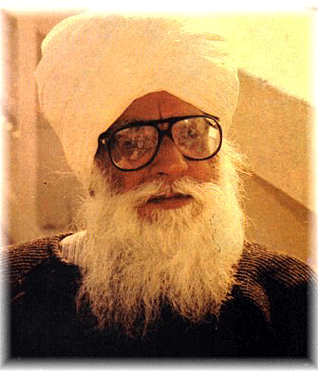
The modern day Prof Darshan Singh ' Bhasauria' a stooge to the agents of social control, just like Teja Singh 'Bhasauria' was to the British colonialists.


The Panj Baniya read when a Sikh takes amrit to join the Khalsa, and become a Singh and Kaur are: Japji, Jaap, Sudh Svaiye, Chaupai, and Anand Sahib. Then the Ardas from Chandi di var is read. This means that 3 out 5 baniya are from the Dasam Granth plus the Ardas. The Amrit is made with a Khanda and this ritual is a form of Shastar Puja. The Bhagauti or Shakti is an intergral part of Shastarvidya and Kshatri maryada. Teja Singh Bhasauaria (1919), Giani Bhag Singh (1976), Prof Darshan Singh (2009), have all attacked the Sikh Ardas. They have called for Bhagauti to be changed to Satinamu. These are all attempts to removed the Holy Double-Edged Sword out of our Warrior Dharam, and make us into a bunch of impotent mendicants. The Khalsa is a Bhagat but also uses Bhagauti as a Khalsa is a Saint and Soldier. Don't let these Biprans who are followers of Ahinsa spread misinformation. Stand up against them intellectually and tell the Sangat what Sikh history actually records! Khushiya de jaikara gajavey nihal ho javey Sat Sri Akal Gurbar Akal Degh Tegh Fateh Panth ki Jeet har maidan Fateh!


Babu Teja Singh (1867 - 1933), leader of the Bhasaur school of fundamentalism, was born on 20 January 1867, the son of'Subadar Sudh Singh and Jion Kaur of the village of Bhasaur in present day Sangrur district of the Punjab. His original name was Narain Singh.

Having received his preliminary education in Punjabi and the Sikh sacred texts under Baba Fateh Singh Virakt of Bhasaur (d. 1875), he studied in Government Primary School, Lang, near Patiala, and matriculated from City High School, Patiala, in 1882. He joined the Patiala state army as a havildar (sergeant) in 1882, but resigned three years later to undergo overseer's training at Engineering College, Roorkee, and was after completing the course appointed a suboverseer at Sirhind in the irrigation department of Patiala state on 21 November 1887. The term babu, a common mode of address for junior government officials, soon came to be prefixed to his name.

While still in service, he started preaching the tenets of the Sikh faith as interpreted afresh by the Singh Sabha movement. In 1893 he established a Singh Sabha at his native village, Bhasaur, and in the following year he compiled and published Khalsa Rahit Prakash, a Sikh code of conduct. During that year he went on a pilgrimage on foot to Hazur Sahib, Nanded, where lie received pahul or the rites of the Khalsa and was renamed Teja Singh. By his dedicated work in the Singh Sabha, he won wide recognition and, when the Chief Khalsa Diwan was established at Amritsar in 1902, he had the honour of saying the inaugural ardas or prayer.

On 1314 June 1903 he convened a largely attended divan or religious assembly at Bakapur, a small village in Jalandhar district, at which a Muslim family of seven and 28 others were administered pahul. He was nominated a member of the committee set up by the Chief Khalsa Diwan, on 20 October 1910, to draft a Sikh code of conduct, later published under the title, Gurmat Prakash : Bhag Sanskar. But Teja Singh's innate puritanism gradually asserted itself and he started drifting away from the mainstream of Sikh life. In 1907 he set up the Panch Khalsa Diwan or Khalsa Parliament under sanction from a Sikh synod held at Damdama Sahib, Talvandi Sabo, on 13 April 1907. In 1909 he opened a girls school at Bhasaur called Khalsa Bhujangan School where the pupils were required to don turbans like men instead of the traditional women's dupatta or scarf. Babu Teja Singh replaced the Sikh term for God "Vahiguru," by "Vahugur." The word karah prasad, Sikh sacrament, was substituted by mahaprashad. Teja Singh publicly repudiated the Sikh code published by the Chief Khalsa Diwan, Gurmat Prakash :

Bhag Sahkar in the preparation of which he himself had earlier participated, and issued his own code, Khalsa Rahit Prakash. He propagated the use of Sikh calendar beginning from the birth of Guru Nanak in AD 1469, and introduced his own titles and honorifics such as Kirpan Bahadur, Kakar Bahadur and Dahra Bahadur. A motion adopted by the Pahch Khalsa Diwan (Khalsa Parliament) disclaimed the Sahajdhari section of the Sikhs. In his literalist zeal, Teja Singh started garbling the Sikh canon and changed the traditional Sikh ardas or daily prayer of supplication.

He advocated the expunging from the Guru Granth Sahib of Ragmala as well as of compositions of the Bhaktas and Bhatts. He printed courses of reading for his school comprising barn contained in the Guru Granth Sahib, extracting from it the Bhatts' Savaiyye. He also had copies of the Holy Volume printed without the Ragmala. He was first person who rose voice against Dasam Granth. This led to widespread public protest and the Shiromani Gurdwara Parbandhak Committee, at its special meeting held on 31 March 1928, condemned the innovations introduced by the Pahch Khalsa Diwan. At its meeting on 15 July 1928, the Committee appealed to the Sikhs in general to boycott Babu Teja Singh and his colleagues of the Bhasaur Diwan and to the Takhts to excommunicate them.

Accordingly, the Akal Takht at Amritsar issued the excommunication decree on 9 August 1928. Other Takhts followed suit, Takht Sri Hazur Sahib, issuing a hukamnama on 13 January 1929, Takht Sri Patna Sahib on 27 March 1929 and Takht Sri Kesgarh Sahib on 22 August 1929. But Teja Singh was far from repentant. Teja Singh suffered a sunstroke on 17 June 1933 and died on 29 August 1933.

References
1.Lal Singh, Itihas Ranch Khalsa Diwan Sambandhi SuchnaVari. Ludhiana, 1967
2.Vir Sudhar Pattar arthat Sri Guru Singh Sabha Bhasaur de athme te naume salana divan da sitta. Bhasaur, 1903
3.Harbans Singh, "The Bakapur Diwan and Babu Teja Singh of Bhasaur," in The Panjab Past and Present. Patiala, October 1973

Saturday, 8 January 2011

The robot has to become a man oneday....

A man who lives through conscience becomes hard. A man who lives through consciousness remains soft. Why?--because a man who has some ideas about how to live, naturally becomes hard. He has continuously to carry his character around himself. That character is like an armor; his protection, his security; his whole life is invested in that character. And he always reacts to situations through the character, not directly. If you ask him a question, his answer is ready-made. That is the sign of a hard person--he is dull, stupid, mechanical. He may be a good computer, but he is not a man. You do something and he reacts in a well- established way. His reaction is predictable; he is a robot. The real man acts spontaneously. If you ask him a question, your question gets a response, not a reaction. He opens his heart to your question, exposes himself to your question, responds to it....

Wednesday, 15 December 2010

Guru Gobind Singhs Eagles nearly extinct

http://www.sikhnet.com/news/baaj-verge-extinction

Confusion reigns over the population of the threatened species of Baaj (Eastern goshawk), which holds significance for its association with the 10th Sikh guru. With no census on the bird available with the Punjab Government, the bird is on the verge of extinction.

Sources in the state Wildlife Department said a notification issued by the state government in 1989 mentioned that the State Bird of Punjab is Baaj. However, this bird seems to be sliding towards extinction and the state government has “failed” to either carry out a census or raise some breeding ground for it.

Talking to TNS, state Chief Wildlife Warden Gurbaj Singh said: “There is no data available on its population with us, as it is now spotted very rarely in the state. Though I cannot say if it was given the status of a State Bird due to its association with the 10th Sikh guru, it is impossible to identify this bird as both male and female goshawks look same and there is no arrangement for its breeding.”

Karamjit Singh Jattana, a former Divisional Forest Officer (Patiala), said the Punjab Government had failed to order any study to associate Baaj with the 10th Sikh guru or initiate steps to protect it from extinction. “Instead, it accepted a Central government grant for the breeding of falcon and ignored Baaj, which is almost extinct,” he added.

State Minister for Wildlife and Forests Tikshan Sud said he was not sure if there was a difference between a falcon and eastern goshawk but officials of the Wildlife Department must clarify it. “However, I will ask officials to conduct a detailed study on this topic and if Baaj is extinct or needs breeding ground, facilities should be made available,” he added.

Thursday, 14 October 2010

Questionnaire for Sikh needs in the health service

Vaheguru ji ka Khalsa Vaheguru ji ki Fateh


I am a Trainee Clinical Psychologist completing the final year of my Doctorate at University College London. As a part of my studies, I am undertaking a thesis which will examine the attitudes of adult Sikhs residing in the UK and really require the support/co-operation of the Sikh community.

The thesis will explore knowledge, attitudes and perceptions of the Sikh community, with regards to difficulties experienced by other people. Research to date on this population is limited. The needs of the Sikh population within the NHS are unknown as a result, and policies and procedures are not tailored to incorporate the requirements of this group in relation to mental health. In order to help make an impact at policy and procedure level within the NHS, a large response rate will be required for this survey. I make a humble request, that you take 10-15 minutes out of your day in order to complete an online questionnaire. Your participation can most definitely pave the way for a greater understanding of Sikh specific needs in the health service.

Just click here and go straight to the Questionnaire

English version: -

Punjabi version: -

We are only interested in real and honest views, not right or wrong answers. It is the understanding of real Sikh attitudes that will enable instrumental steps to be made towards tailoring important public services towards the community.

If you could treat this study as a community project and promote/advertise it within Sikh circles/groups/Gurdwarai in your local area, you will be doing a great service to the Sikh community. Also, kindly forward this e-mail to all the Sikhs (friends/family etc) you know and put the details of this message on any internet Sikh forums you participate in etc.

Many thanks for your help.

Gurpreet Kaur
Trainee Clinical Psychologist

Monday, 16 August 2010

Punjab: The New Food Wars: Globalization GMOs and Biofuels


Scientist and activist Vandana Shiva explores whether the future will be one of food wars or food peace. She argues that the creation of food peace demands a major shift in the way food is produced and distributed, and the way in which we manage and use the soil, water and biodiversity, which makes food production possible. 17th Annual Margolis lecture at UC Irvine.

Enhanced by Zemanta

Filmmaker Nav Kandola discusses the problems in the Punjab, and a solution hemp farming.

Bhang goes da Green Revolution from Nav Kandola on Vimeo.


Monday, 5 July 2010

Sikh Reference Library to get new lease of life

Varinder Singh
Tribune News Service

Amritsar, June 30

Irked over the Centre’s dilly-dallying attitude over returning books and other valuable treasures of the Sikh Reference Library to the SGPC for more than 25 years , the apex Sikh body has finally undertaken the onerous task of resurrecting the library on its own.
The Army is yet to return valuable items like manuscripts, paintings, books and other important articles of the library after it had allegedly removed these items from inside the Golden Temple complex in the aftermath of Operation Bluestar in 1984.
The SGPC has been urging the Central Government to facilitate an early return of the Sikh treasures since 1984, but all its pleas have failed to yield any result so far. The assurances extended to the SGPC by the former President of India, Dr Abdul Kalam, and by the Prime Minister, Dr Manmohan Singh, regarding ensuring return of the valuable articles to the SGPC during their visits to the Golden Temple, too, are yet to be honoured.
After waiting for too long, now the SGPC has taken upon itself the task to resurrect the library by installing a couple of computers and constructing a fumigation chamber for the preservation of handwritten manuscripts and other books of historical and religious importance.
“Our efforts have started bearing fruit. Baba Narinder Singh, Chief Manager of Gurdwara Sri Guru Granth Sahib at Chhoti Jawaddi in Ludhiana, has offered 30 handwritten “Saroops” of Guru Granth Sahib and 29 other handwritten books to the SGPC. These have been installed in the library as per Gursikh Maryada,” said the SGPC Secretary, Dalmegh Singh.
The SGPC Publicity In Charge, Bhai Ram Singh, said the SGPC had issued an appeal to the Sikhs to come out with any handwritten or other articles and hand these over to the SGPC on payment or donation basis so that these could be preserved in the library for the benefit of future generations.


http://www.tribuneindia.com/2010/20100701/punjab.htm#4
Enhanced by Zemanta